🧿The Enshittification of D&D

*Ironically, I originally posted this on Reddit, but that got me banned (more on that below). Another platform in the midst of enshittification that even more ironically has an enshittification subreddit.
I started reading Enshittification: Why Everything Suddenly Got Worse and What to Do About It and saw the path laid out that Dungeons & Dragons is following.
What does “enshittification” actually mean?
It doesn't mean "something got worse".
- The platform serves two groups, the users and the businesses.
- The platform starts off with a high-quality offer to attract users.
- Once it has become dominant and users are locked in, it degrades the user offering by better serving its business partners (think advertising, third-party plugins, etc.).
- Gradually it shifts to maximizing profits for the shareholders and degrades the experience for both users and business partners who are both trapped in the relationship based on the monopoly the platform exploits.
Rather than being a game, D&D has become a platform owned by Hasbro and is following the same enshittification pattern we’ve seen with many platforms such as Facebook.
D&D’s platform consists of:
- Users (Players and DMs)
- Businesses (Third-Party Publishers, Local Gaming Stores, Licensors such as Baldur’s Gate 3, etc.)
Small Publisher Perspective
Being an avid player and a small publisher gives me the perspective on both sides of the table.
The SRD (Standard Reference Document) was a genius marketing move to ensure D&D was the dominant TTRPG. Before Creative Commons was a thing, this document replicated the intent and made the game extremely easy to make content for (the platform begins!).
 Contributors to Wikimedia projects
OGL History on Wikipedia, including the proposed changes of 2022/2023
This incentivized third-party publishers to build on D&D rules with the blessing of D&D. This ensured there was a lot of content for D&D and drowned out other options. This cemented the dominant position of D&D in the TTRPG market.
Seen through the enshittification lens, a lot of recent developments make sense:
- Degrading Business Partner Experience: The OGL (Open Gaming License) updates would have increased revenue and control for Hasbro while harming their business partners and reduced content available to users.
- Digital Platform: The D&DBeyond acquisition replaces ownership with digital leases. Third-party books give you PDFs you own forever which can be shared. D&DBeyond gives you a lease tied to its platform and you can pay for the subscription to share your content with others. If the platform goes away or products are removed, you lose access to them because you don’t own a copy of them.
- 2014/2024 Version: The confusion around the 5E version (2014 versus 2024) provides monetization for Hasbro with new books while complicating business partner direction. They finally confirmed versioning, kind of...
 Harvey Randall
It's only 5.5E on D&DBeyond...
- App Store: Turning D&DBeyond into an app-store-style ecosystem puts Hasbro in control of the interaction between players and third-party publishers.
- Market Share: D&D’s sheer size makes it hard for players and publishers to pivot away, even when they want to. It can be extremely difficult to find a group to play with that's using something other than D&D.
- Convenience and Player Monetization: D&DBeyond removes the complications of building and managing your characters, but you have to pay to have more than 6 characters. This is a way to monetize players further, which has always been a challenge if most books are bought by the DM and the DM shares with their players.
- Future User Degradation Opportunities: Following the enshittification playbook, it would behoove Hasbro to make character building and management more complicated, not less. This would degrade the user experience, increase the value of their character builder, and drive additional revenue through what feels to many like a mandatory subscription to keep playing. It doesn't need to be intentional. Assuming access to the tools and capabilities of a digital system can allow for more complicated designs. These designs make it more difficult to play without the digital system until eventually it becomes all but impossible.
Tabletop RPGs haven’t succumbed to the enshittification process as quickly because so much still happens offline at the table. People can buy physical books, run games without apps, and support small publishers directly through crowdfunding, publisher websites, and purchases at conventions or local game stores. Its possible to play the game for free by using the SRD:
 Jay Jani
"The purpose of the SRD is to provide a foundation of Dungeons & Dragons content on which third-party publishers can build their products."
But participation increasingly requires Hasbro’s digital platform:
- Distribution Partnership Cancelation: Hasbro stopped distributing through Penguin Random House and is doing both physical and digital sales through D&DBeyond.
 Linda Codega
- Taking a Cut: Third-Party Publishers are beginning to be invited to list their products on D&DBeyond.
- Walled Garden: Anecdotally, I get 1 or more comments a week that the individual only plays content available on D&DBeyond. Even if my content looks amazing for that individual, they will have to pass on it until it is available on Hasbro’s platform.

- Physical Viability: Digital distribution makes physical locations less viable (think Blockbuster and GameStop).
- Digital Only Releases: There are products only available on D&DBeyond without a physical release, DLC video game model.
 Jody Macgregor
I asked 1k people:
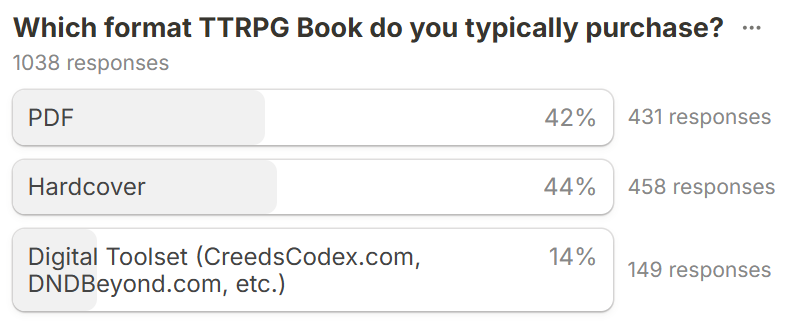
Let's pretend this survey shows the exact breakdown of the entire D&D player base. You might be thinking only 14% prefer a digital toolset.
This analysis is missing two crucial details:
- Subscription customers typically have a 2x-3x higher lifetime value than traditional purchase customers and create predictable revenue.
- The subscription is also easier to fulfill than the costs associated with a physical book (printing, shipping, storage, returns, etc.), so your margins are higher per customer because you primarily have fixed costs with minimal variable costs. The costs of creating the website are mostly fixed regardless of your user count, just like the cost to write, illustrate, edit, and layout a book. However, your cost to deliver the website versus the book is dramatically different.
Depending on that profit margin, those 14% of people may provide more profit than the other two groups combined. If Hasbro stops offering anything outside of their digital platform, some of those people preferring PDFs and Hardcovers will convert and bolster that number further.
Once a user is on the platform, they are easier to control. If the user leaves the platform, they lose their “books”.
This stage isn’t about what the customer wants, it’s what makes the most money. Alienating the majority of its customers might be worth it if the goal is short term profit for shareholders.
Reddit Banned Me For This Article
As part of the experience writing this article, I saw the swift and brutal truth of enshittification in action. Platforms have extreme/complete control once they've reached a dominant position.
I posted this on Reddit; I've been banned.
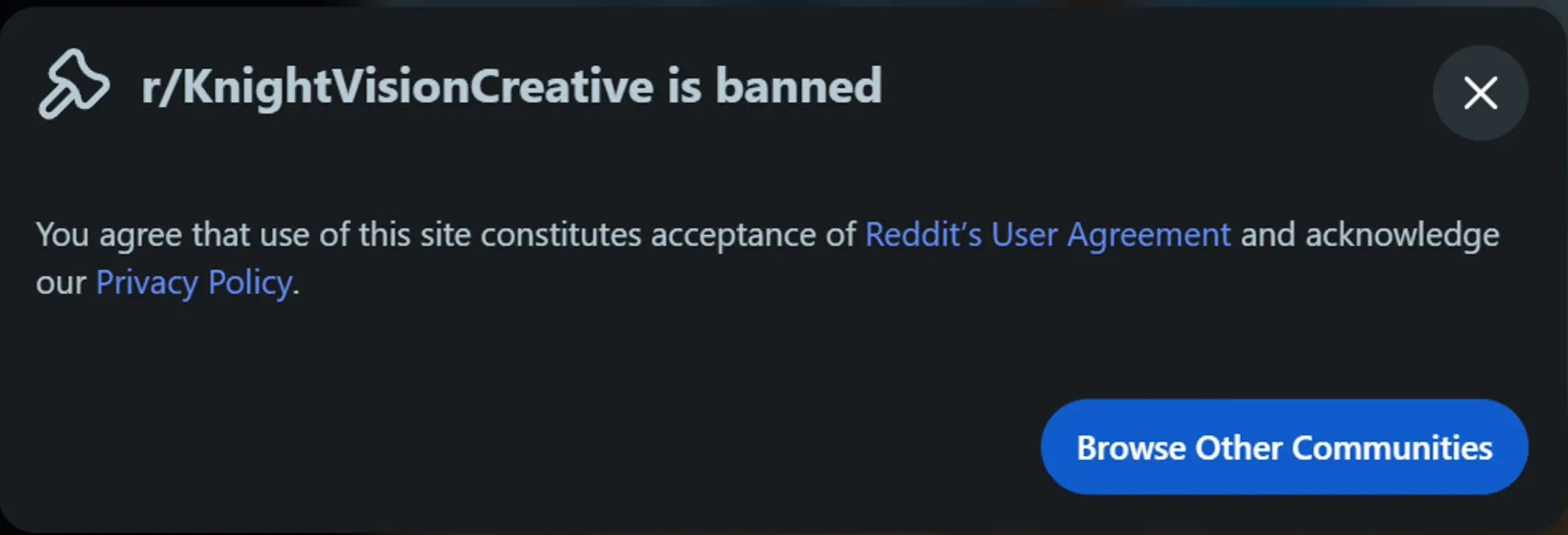
When I asked Reddit why, I never heard back.
The mods of r/DND have been awesome and were nice enough to let me know I was shadowbanned, though I wasn't able to let them know!

I was completely blocked from the site shortly thereafter.

Filing a ticket did nothing and was unbelievably perfect timing for an example of enshittification in action. The platform is too big, I am too small, and there is no recourse.
If D&DBeyond restricts your access, even on accident, you have lost your digital books until it is restored.
This is an issue affecting a lot of platforms as they move through their lifecycle. Discord's CTO is worried about it on his own platform!
 Igor Bonifacic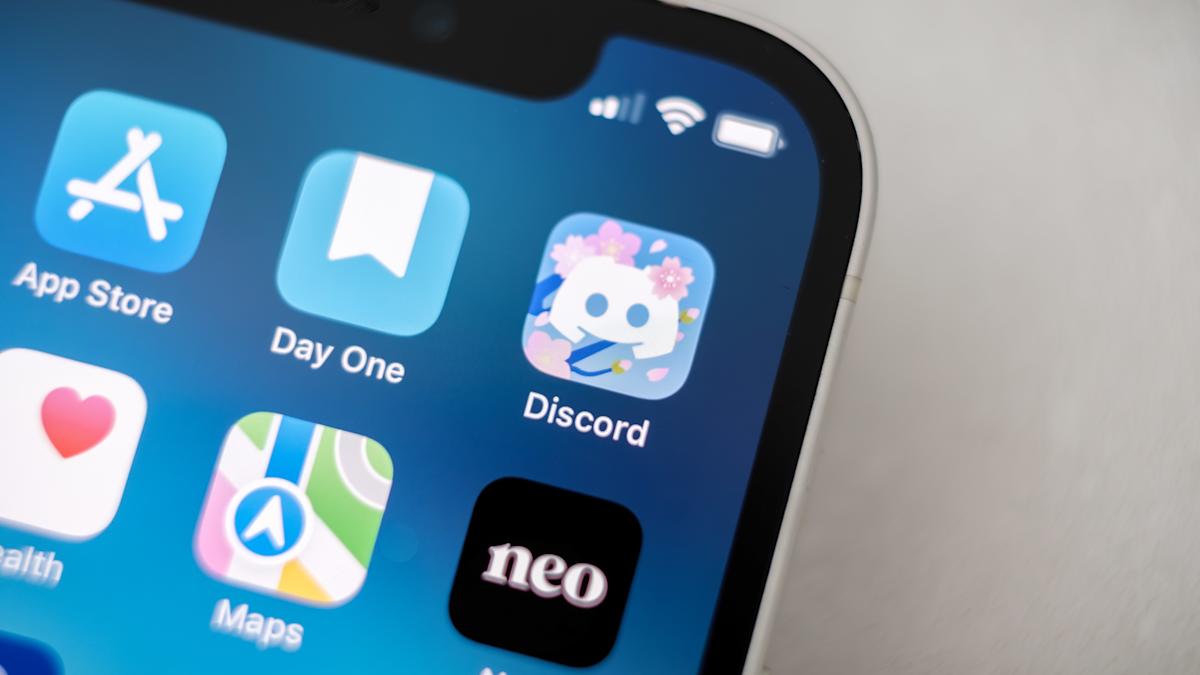
So, Now What?
It appears Hasbro is taking the wrong lessons from companies like Blizzard.
 Christine Miller
“You’re wondering why these companies do microtransactions? Because dipshits keep buying all of them."
I love D&D, so what can I do?
Me too! You don’t have to quit D&DBeyond, cast Fireball on your books, or retreat into your Tiny Hut.
But you do have choices and need to recognize the consequences of making them. They matter in aggregate:
- Own your rules when possible. Physical books and PDFs don’t disappear when terms of service change. Comparing D&DBeyond digital versions to PDFs doesn’t give third-party publishers credit where credit is due. You can share your PDFs with your gaming group for no additional cost and should the publisher go belly up as they get squeezed out, you still have those PDFs forever.
- Purchase products through non-platform routes. Buy from publishers’ stores, conventions, or your local game stores instead of platform-locked marketplaces when possible.
- Understand what D&DBeyond is offering. Use it if it helps you, but you should recognize the true cost of that convenience.
- Pay attention to licensing changes. The OGL update mattered for many reasons, but the biggest might be revealing intent. The best thing for a passionate game company is to have loyal players and business partners that want to play their game forever. The worst thing for a profit driven company are players who only buy one book (or no book) and play that game forever without making another purchase.
- Talk about this openly. Enshittification thrives on apathy and fragmentation. Awareness in the community is the biggest counterweight. Luckily, we have an extremely outspoken community that fights to protect each other.
I want to be clear that subscriptions/digital platforms aren't inherently bad. They can solve real problems for users (14% even prefer them for D&D in my dataset):
- Low monthly price instead of a large upfront cost
- Great opportunity to try something out with minimal risk
- Convenient and centralized
- Continuous improvements
- New features can be added without an additional purchase
- Only subscribe when you need it
It's like the difference between a home gym and a gym membership. Depending on the person, these subscriptions can make a ton of sense. You may not want (or be able) to buy and maintain all the equipment and a space big enough to put it.
Subscriptions and digital purchases tied to a platform become dangerous when they replace ownership AND make exiting painful.
I love the idea of a digital database of everything D&D and digital tools to supplement (supplement, not replace!) physical books. It's just a dangerous one. The more dominant this platform becomes, the stronger the control Hasbro has over the game as a whole.
They haven't proven themselves to be stewards worthy of that role.
If the gym starts to suck and you want to go to another one, you may have to pay a termination fee, but you’re not losing access to the equipment for life, you can get access to that same type of equipment at the next one.
Haven't picked up the free 200+ page Tome of Endless Wonders yet? Download this free 5E PDF and see for yourself why it's rated 4.75/5⭐